Prologue :
   
"The WereWolf mythos underscores, in part, impulse control issues analogous to the teenage male id. When one considers that werewolf films are generally targeted at gore-gorging teenage boys whose subconscious minds are busy fathoming the sudden arrival of body hair, voracious appetites, manic bursts of energy and sexual compulsion, the puberty-metaphor seems quite apt...of course after a while the male subconscious settles back into a far more free- form studies of monster trucks, belly button lint and shotguns ".
the Tale of Red Ridin' Hood : barbarum successit civilitas.
     Versache the Barbarian   \ Celtic Mythology \Origin of the tale of Red Riding hood\Loup-garou\Faoladh\Conriocht\updated 29 Dec 08

Artwork Details :
     Artists Description and comments relating to characters and concepts.

Client : Versache the Barbarian comic book ( in association with Ian Versace.)
Medium :
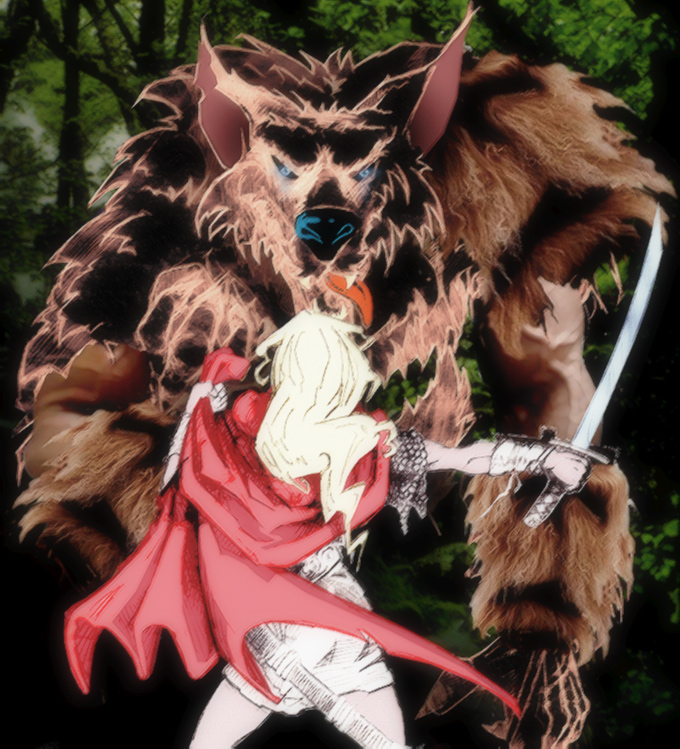
Pen Sketch (on Cartridge) 20cm by 28cm : Still a work in progress.
Character Design :
Versache the Barbarian's Mother, being the origin of later legends and tales pertaining to Red Riding Hood. Coloured and Enhanced in Adobe Photoshop 2006 a.d.

Additional notes :

For the famous Fairy tale, 'Le Petit chaperon rouge' (little Red Riding Hood--The Complete Fairy Tales of Charles Perrault ) Charles Perrault adapted a traditional story, in which a little girl takes food and drink to her grandmother and meets a wolf. It is likely he set aside aspects which struck him as crude but which survived in later retellings:

There are many interpretations of the classic fairy tale, many of them sexua lin nature. Four are listed below.

Moon/Sun myth :

Little Red Riding Hood may be an ancient story relating to wolf-clan traditions. The tale includes all the details of the myth: the red garment, the offering of food to a grandmother in the deep woods, a grandmother who wore a wolf skin, and the cannibalistic motif of devouring and resurrection. The story's original victim would not have been the red-clad Virgin but the hunter, as Lord of the Hunt. Other  early interpretors saw the tale as a solar myth, with the wolf (the terror of the night) swallowing the sun (Little Red Riding Hood).

Redemption :

There is a social-class element in the later stories.  Zipes suggests that the red cap (chaperon) signified the village girl's nonconformity, in that such caps were worn by the aristocracy and middle classes, not the peasantry. Thus, she is a more rebellious and individualistic girl - the kind that could easily be drawn into trouble by her natural inclinations.  In 17th-century ideology, she is a potential witch, and her nature is confirmed by her pact with the diabolical wolf. Numerous subsequent versions connect this to the seduction of bourgeois women by aristocratic men.  As tales are retold by men (i.e., Perrault), of course the woman is the one who has sinned and must be punished, so she is eaten (obvious sexual imagery) by the wolf; insofar as her individualism has led her into trouble, she must be safely eliminated by death. With the Grimms, the idea of justice has changed and she can be resurrected as a reformed, more obedient girl, the woodcutter/policeman having destroyed the seducing wolf.

Prostitution :

One of the more common interpretations refers to a classic warning against the worlds oldest profession, going on 'the game' or becoming a "working girl",if you wuill. This builds off the fundamental "young girl in the woods" stereotype. The red cloak was also a classic signal of a prostitute in 17th century France. A Colombian charity recently used this theme in a poster campaign that showed various fairy tale characters reduced to child labour, including Red Riding Hood as a child prostitute

Sexual awakening :

Red Riding Hood has also been seen as a parable of sexual maturity. In this interpretation, the red cloak symbolizes the menstrual cycle and the entry into puberty, braving the "dark forest" of womanhood. Or the cloak could symbolize the hymen (earlier versions of the tale generally don't state that the cloak is red--the word "red" in the title may refer to the girl's hair color or a nickname). In this case, the wolf threatens the girl's virginity. The anthropomorphic wolf symbolizes a man, who could be a lover, seducer or sexual predator.When Little Red matures, she gives up her cloak, deciding she doesn't need it anymore. This can be viewed as deciding to no longer hide from the wolf (representing her own sexuality), or as the literal giving up of the cloak of the hymen.


" OH! YE IMMORTAL Gods!
What is Theogony?
Oh! Thou, too, mortal man!
what is philosophy?
Oh! World, which was and is,
what is Cosmogony?
Some people have accused me of Misanthropy;
And yet I know no more than the mahogany
That forms this desk, of what they
mean;-Lykanthropy
I comprehend, for without transformation
Men become wolves on any slight occasion. "
The Works of LORD BYRON
Poetry. Vol. VI.
versache the Barbarian logo

Notes on the life and times of Versache the Barbarian :
Ex libris necessarius Versache obscurus barbarus :
This extraordinary collection offers striking insight into the historical Versache the barbarian.
Compiled, Photographed, Edited, Rebound and Translated by Marjorie Chillblaine :

Today the most ancient of the original documents exist beginning with 600 leaves (or folios) made from hemp, Some folios are of single sheets, most are twice the width, then folded to accommodate 2 pages of text, The decorated pages often occurred on single sheets. The folios had lines drawn for the text, sometimes on both sides. Prick marks and guide lines can still be seen on some pages. The hemp is of high quality, although the folios have an uneven thickness, with some being almost leather, while others are so thin as to be almost translucent. Food, beer and coffee stains abound throughout
...

"Chi mi Sgorr-eild 'air bruaich a 'ghlinn
An goir a’ chuthag gu-binn an dos.
‘Us gorm mheall-aild’ nam mile guibhas
Nan lub, nan earba, 's nan lon."

"I see the ridge of hinds, the steep of the sloping glen
The wood of cuckoos at its foot,
The blue height of a thousand pines,
Of wolves, and roes, and elks."

 
ancient Gaelic lay, unknown author.
 

Concept Notes :

With the glacial retreat of the last Ice Age, wolf packs followed the great herds of grazing animals pushing north and west to again colonise most parts of what was to become the British Isles. InScotland wolf bones have been found, together with those of reindeer, northern lynx, brown bear and arctic fox at the Creag nan Uamh caves in Inchnadamph National Nature Reserve in Sutherland, and on Crossflat at Muirkirk in Ayrshire. At the latter site, near the upper reaches of the River Ayr, the lower jaw of a wolf was discovered along with the remains of red deer and aurochs, the giant wild ox that inhabited Scotland into Mesolithic times and probably even later. From these and other remains it seems likely that the Scottish wolf, was similar in size and form to wolves living in Europe today. Skeletal remains of wolf that date from historic times, however, are hard to separate from those of the very large hunting dogs which were legendary in Iron Age Britain. All dogs are now considered to be descended from the wolf, and although the split between wolves and domestic dogs occurred far back in time, certainly before the Mesolithic period, dogs and wolves can interbreed and produce viable offspring to this day.

( excerpt from The Werewolf in Lore and Legend by Montague Summers (1880-1948)--
Long after he had been extirpated in England the wolf continued to be " rycht noysum to the tame bestiall in all partis of Scotland ". Camden at the end of the sixteenth century remarks that Strath-Navern, " the utmost and farthest coast of all Britaine," is " sore haunted and annoied by most cruell wolues ", who not only set upon cattle but also " assaile men with great danger, and not in this tract onely, but in many other parts likewise of Scotland ". But a hundred years after Sir Robert Sibbald avers that the animal had been wholly exterminated. Although their numbers were no doubt greatly diminished, especially after the great hunts arranged in the days of James V (born 1512, died 1542) and Queen Mary, his daughter, actually it was not until the year 1743 that the last of the species was destroyed at a remote spot between Fi-Giuthas and Pall-achrocain.
One winter day the Laird of Macintosh was apprised that a large " black beast " supposed to be a wolf had been descried prowling in the glens, and less than twenty-four hours before had killed two children who were crossing the hills from Calder. A " Tainchel " or general drive was at once proclaimed, and amongst others summoned to the meet not the least important was a famous deer-stalker, MacQueen, who had the fleetest and strongest hounds in the country. All assembled at the tryst had waited long impatiently expecting MacQueen's arrival ere he appeared on the scene. Macintosh began to upbraid his unusual tardiness, when for answer the hunter lifted his plaid and threw the bleeding head of the wolf at the laird's feet, to be overwhelmed with congratulations and well feed in a generous gift of land for his prowess.
Even later did the wolf maintain his hold upon Ireland, where formerly he existed in such numbers that a special breed of dog, a tall rough greyhound of exceptional size and power, and most highly esteemed, the Irish Wolf-hound, was especially reared to hunt the fierce and fearful packs. " They are not without woolues and grayhoundes to hunt them, bigger of bone and limme then a colt," says Holinshed in his description of Ireland," and Camden writes, " much noisance they have everywhere by Wolues." Thus in the Travels of Cosmo the Third, Grand Duke of Tuscany, through England in 1669, wolves are spoken of as common in Ireland, which indeed had acquired and long kept the nickname of " Wolf-land ".
"Wolves still abound too much in Ireland," Harting quotes from The Present State of Great Britain and Ireland,
1738 ; and in an article on the Irish Wolf-dog printed in The Irish Penny Journal for 1841, Mr. H. D. Richardson says :" I am at present acquainted with an old gentleman between eighty and ninety years of age, whose mother remembered Wolves to have been killed in the county of Wexford about the years 1730-1740, and it is asserted by many persons of weight and veracity that a Wolf was killed in the Wicklow Mountains so recently as 1770."
In his Origins of English History Charles Isaac Elton draws attention to the fact that there was no more usual periapt among the ancient Britons than " crescents made of the wolf's teeth and boars' tusks perforated and worn as charms ". He also remarks, " We know that at one time the wolves swarmed in Sherwood and Arden "; and emphasizes that " the wolf and wild boar lingered until the end of the seventeenth century in the more remote recesses of the island ", a generalization which is perhaps not strictly accurate, since, as we have seen, the wolf in England was extinct early in the sixteenth century, and in Scotland was not finally destroyed until the fourth decade of the eighteenth.
That werewolfism was a sorcery not unpractised by Anglo-Saxon warlocks is very certain, although the records are neither numerous nor detailed. It is not surprising that many erroneous beliefs had grown up concerning these demoniac wolves which the Bishops and priests were at some pains to correct.
In an old Poenitentiale Ecclesiarum Germaniae, occurs the following: " Hast thou believed what some were once wont to hold, namely that those who are commonly called Parcae can effect what they are often supposed to effect, namely that when a man is born they can direct and achieve his destiny, and moreover by a magic spell whensoever certain men will they are able to transform themselves into wolves, and such a one of this kind is called (teutonica) "Werewulff", or else they transform themselves into an other animal shape as they list. If thou hast believed that Man made in God's Image and Likeness can be essentially changed into another species or form by any power save that of Almighty God alone, thou must fast therefor ten days on bread and water."
In England a precisely similar clause, xv -" whosoever shall believe that a man or woman may be changed into the shape of a wolf or other beast..."- occurs in the Poenitentiale of Bartholomew Iscanus, Bishop of Exeter, who died 1184. It should be carefully remarked that no denial of werewolfism is implied, that was far too real and too terrible a sorcery, but it is insisted that there must be a right theological understanding of this dark matter. For many had been reduced into giving the Devil an almost unlimited power, and thus betrayed into the most horrid impiety.
Although it has already been quoted, we may not impertinently remind ourselves of the well-known passage in Gervase of Tilbury's Otia Imperialia, written during the years 1210-14, where he speaks of the English werewolves, men who are thus metamorphosed at the changes of the moon, adding that such shape-shifting was then by no means uncommon in this island. He returns to the same subject a little later in his work, and chapter cxx 31 is sufficiently important to be quoted in full : " Of men, who were wolves. It is often debated among the learned whether Nabuchodonosor during the allotted time of his penance was indeed essentially metamorphosed into an ox, since all...


Search This Site :
     Recent updates may not appear in search query.

Web www.arkhamhaus.com

"The Brazilians call the bagpipe gaita de foles, which is Portuguese for "screams of the tortured monkey"
Similar ArtWork :
Island of the fay Island of the Fay :
Updated 24/09/07

Angelica Angelica :
Updated 10/02/07
Albino Werewolf new as yet unfinished 15/05/05 Were-Wulf :
unfinished 15/05/05
Related Reading :

Music to draw to :


All music, literature and cinema advertised within this website has passed through my personal collection and reflects my distinctive taste and inspirational sources.